
If hormone imbalances affect you, you’ll know how disruptive they can be to your health and wellbeing. In this article, you’ll discover how seed cycling can support healthy balanced hormones.
Because hormones influence every single cell in your body, the symptoms of hormone imbalance can occur pretty much anywhere. For now, we’ll be concentrating on the female reproductive hormones oestrogen and progesterone.
These hormones fluctuate according to a natural rhythm over time. Any deviation from your normal can create diverse symptoms. Think headaches, mood swings, bloating, digestive disturbances, anxiety and depression. Then there’s weight gain, food cravings, poor energy, joint aches, and problems sleeping – the list goes on.
Collectively, these symptoms are often lumped together as PMS. However, unbalanced hormones can cause heavy, painful and irregular periods, too, as well as problems conceiving, PCOS and fibroids.
Meanwhile, if you’re postmenopausal, hormone imbalances can lead to hot flushes, mood swings and night sweats.
Your GP may offer medication to ease your symptoms, like natural or artificial hormones, painkillers, or antidepressants. However, these mask the symptoms or replace the missing hormones without addressing the reasons underlying the hormone imbalance.
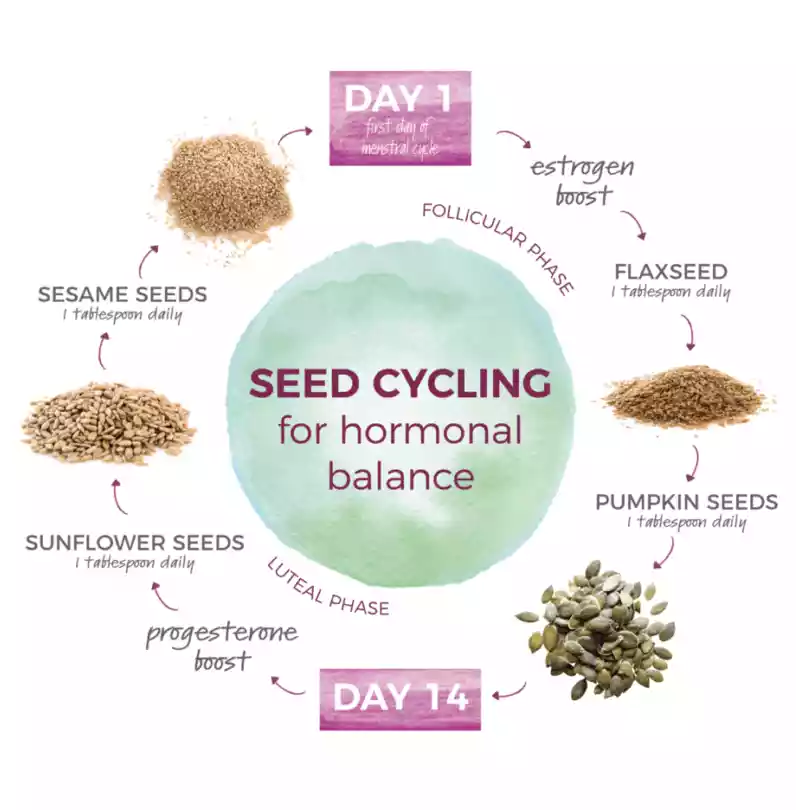
Seed cycling is a natural and holistic approach gaining popularity among functional medicine practitioners looking to naturally balance hormones.
It’s all about eating certain seeds at various times of your menstrual cycle to help regulate hormone levels. The natural substances in seeds can support your body’s natural hormone production and help achieve balance throughout the month.
First, here’s a quick 101 to help you understand your menstrual cycle.
Your menstrual cycle occurs in in two main phases. The follicular phase is the first half of the cycle, around days 1-14. During this phase, oestrogen levels rise as your body prepares for ovulation when an egg is released.
Ovulation usually occurs on or around day fourteen. The luteal phase is in the second half of the cycle, around days 15-28. During this time, oestrogen decreases while progesterone rises. This helps create the conditions needed for a successful pregnancy.
If the egg isn’t fertilised, hormone levels drop at around day 28 and your period will start. Every woman is different, however, and your cycle may be longer or shorter than average.
During the first (follicular) phase, practitioners recommend consuming flaxseeds and pumpkin seeds. These seeds contain plenty of zinc to help support healthy hormone balance 1 as well as omega-3 fats to regulate inflammation 2. They are high in substances called lignans, too. These function as natural, weak oestrogens and can help prevent your body’s oestrogen from climbing too high or from dropping too low 3. This condition is a common cause of PMS-related issues and is known as oestrogen dominance.
During the luteal phase, the emphasis is on eating sunflower and sesame seeds. These contain good levels of vitamin E 4 and selenium. These nutrients can help support healthy progesterone levels. They’re also a rich source of lignans to continue balancing oestrogen levels.
By eating these seeds during the different phases of your menstrual cycle, you can help your body regulate its hormones and restore balance. Because seed cycling naturally encourages your body to balance its hormones, it’s not connected with the side effects experienced with prescription medication.
Monitoring changes in symptoms through a diary can help track the effectiveness of seed cycling. By doing this you can more easily see any changes or improvement. Otherwise, it can be hard to remember how you felt even as little as two or three months previously, especially if your symptoms naturally fluctuate. Consider your cycle length, regularity, your energy levels, and mood, as well as any aspects of your health you mightn’t have imagined were connected with your hormones.
Remember every woman is different, and it might take several months for your body to naturally adjust. Your practitioner may recommend a functional hormone test to evaluate your hormone levels over time. These can be useful to assess baseline imbalances as well as to track any changes over time.
Functional medicine always aims to address the root causes of ill-health, and hormone imbalance is no exception. Your practitioner will discover the contributing factors for you – be they stress, nutritional deficiencies, environmental toxins, gut health, or chronic inflammation, for example. Putting these right will naturally support your body’s healing processes and can bring about lasting and sustainable results.
Seed cycling is only one aspect of a functional medicine practitioner’s toolkit. By using a combination of nutrients, herbs, and lifestyle measures designed to provide your body with the very best opportunity to heal, balance can be restored throughout your body.
If you are struggling with hormone imbalances and are looking for a natural approach to finding relief, contact us today to start your journey to optimal hormone balance.
Do you or someone you care for need personalised support for hormone balance? Then book a free 15-minute discovery call to see if Functional Medicine is for you.
Please enter your details below and we will get back to you as soon as we can.
FOR ALL THE LATEST NUTRITION & WELLNESS NEWS & OFFERS
Login to your account to access your personal dashboard
Create your free account to gain access to free content and a customer dashboard to access your orders, appointments and subscribed courses. A verification email will be sent to the address provided.
The clinic is closed for the Christmas period from the 19th December – 5th January, discovery call requests will be allocated when we reopen after the 6th January.
Please enter your contact details below and the reason for your discovery call and we will get back to you to arrange a suitable time for your FREE 15 Minute Discovery Call